Pod Runner
- 4.3
- Rating
- 10.00K
- Installs
- Free
- Price
 Analysis by App-foxy
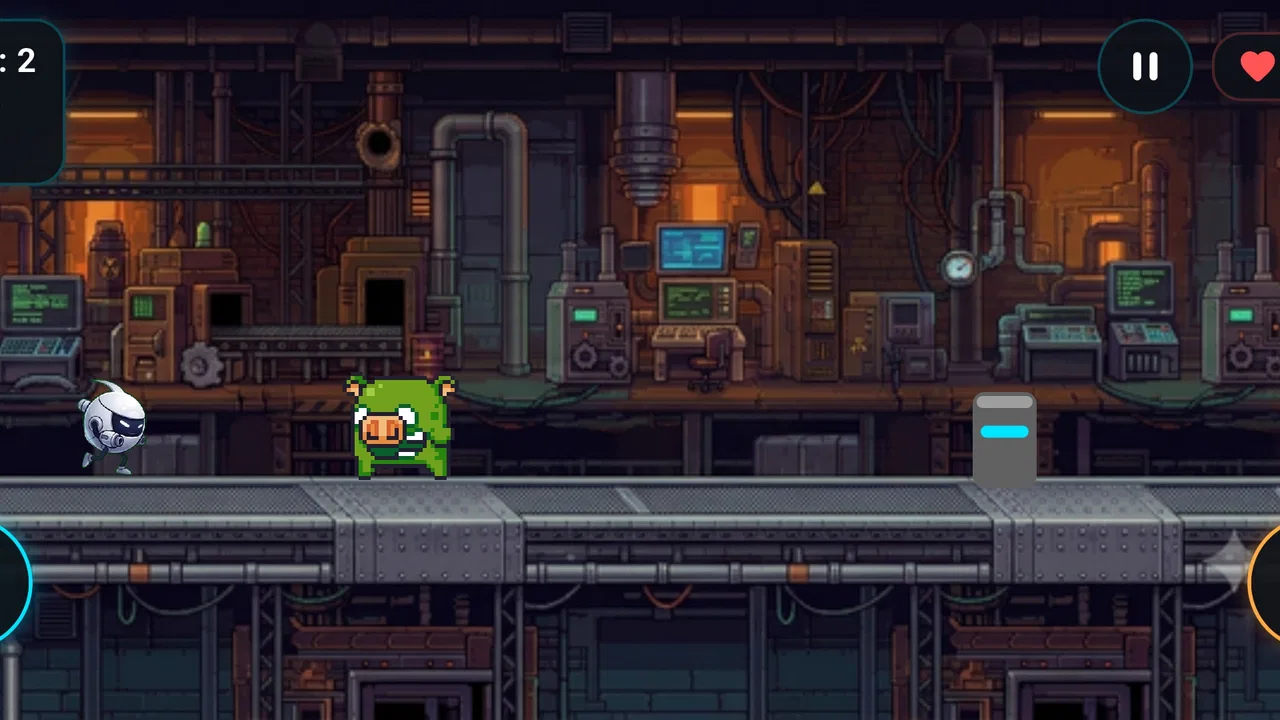
I spent time with Pod Runner as a quick, casual game, and my main takeaway is simple: it is at its best when I want a short burst of concentration rather than a large game to settle into. The idea is easy to understand, but avoiding obstacles can still demand more attention than the plain presentation suggests. That makes it a reasonable choice for a spare minute, a short break, or anyone who enjoys testing reactions without learning a complicated rule set.
Pod Runner is free to download, and its Everyone age rating makes it approachable for a broad audience. It comes from Noman006, has reached over ten thousand installs, and holds a 4.2 average from more than two hundred ratings. Those figures suggest a small but active audience rather than the scale of a major mobile franchise. I think that context matters: this is a focused independent-style casual game, not a content-heavy alternative to a large arcade or action title.
Why the simple dodging idea works
The central appeal is the immediate challenge. I do not need to study a long tutorial or understand a complicated progression system before playing. The game places the emphasis on movement, timing, and reading what is coming next. That low entry barrier is one of its strongest qualities because I can open it when I have very little time and begin playing almost immediately.
You May Also Like

 AccuWeather: Weather Radar
AccuWeather Review: A Quick, Clear Forecast for Everyday Decisions
For everyday plans, the best forecast is the one you can understand quickly. AccuWeather makes rain timing, radar, and local conditions easy to act on, with a few trade-offs.

 Hill Climb Racing
Why Hill Climb Racing Still Turns Crashes Into One More Run
A tiny car, a bumpy hill and one more upgrade: Hill Climb Racing keeps resurfacing because its simple chaos makes every near-miss feel personal.

 AliExpress - Shopping App
AliExpress Makes Global Shopping Feel Personal, but Shoppers Bear the Risk
AliExpress turns a global marketplace into a pocket-sized discovery engine. Its reach is useful, its shopping loop compelling, and its trade-offs easy to miss.

 Lords Mobile: Kingdom Wars
Lords Mobile Is a Kingdom-Building Routine, Not a Quick Match
A case-by-case verdict on the building, battles, device demands, and social commitments that make Lords Mobile rewarding for some players and exhausting for others.

 PDF Scanner app - TapScanner
TapScanner Makes Paperwork Easier to Capture, Check, and Share
TapScanner makes scanning with a phone feel less like a rescue operation and more like a dependable step in getting work done. Its capture tools are useful, though not flawless.

 Block Blast!
 Shows How Much a Puzzle Game Can Leave Out
A quiet grid game shows why puzzle players increasingly value instant clarity, repeatable skill and low-pressure play—and where the genre still needs to catch up.
More From Our News Desk
View All News


Simple controls also make the game suitable for players who are not interested in elaborate mobile interfaces. In a casual dodging game, the quality of the experience depends heavily on whether the response feels understandable. Pod Runner benefits from keeping the objective clear: stay out of danger for as long as possible and improve through attention rather than through a long list of abilities or equipment.
I found that the most enjoyable sessions were not necessarily the longest ones. A short attempt gives me a clear target, while a series of attempts creates a natural rhythm of trying, making a mistake, and starting again with a better idea of what to watch. That loop is familiar, but it remains effective when I want something more active than a puzzle and less demanding than a full action game.
There is also a useful mental shift involved. At first, I tended to react to the nearest obstacle. With more play, I started looking farther ahead and thinking about where the next safe movement would be. That change is a small but meaningful sign that the game can reward practice. It is not just about tapping quickly; it encourages better visual planning and calmer reactions.
A good fit for short, repeatable sessions
The clearest everyday use case is a waiting period. If I have a few minutes before an appointment, during a commute, or between tasks, Pod Runner gives me an activity that does not require a major time commitment. I can play one attempt, put the phone away, and return later without feeling that I have abandoned a complicated story or interrupted a long mission.
That makes it different from many popular casual games that depend on daily rewards, collections, or extended progression. Those systems can be enjoyable, but they also ask the player to maintain a routine. Pod Runner’s attraction is more immediate. I play because I want the challenge in front of me, not because I need to complete a checklist before the day ends.
Another practical strength is its suitability for players who prefer a narrow objective. Some people find large menus, multiple currencies, and constantly changing events tiring. This game is easier to approach because the basic purpose remains visible. For a younger player or someone new to mobile gaming, that clarity can be more valuable than a long feature list.
At the same time, the same simplicity will not satisfy everyone. If I am looking for a story, character development, competitive matchmaking, deep customization, or a large collection of stages, this is not the right destination. A more substantial arcade game will offer greater variety, while a platformer or action game may provide more ways to express skill.
Small techniques that make a difference
One useful habit is to avoid treating every obstacle as an emergency. My first instinct was to make frequent corrections, but that can lead to rushed decisions. Watching the upcoming path for a moment before moving often produces a cleaner response. The game becomes less about frantic motion and more about choosing a safe line early.
I also recommend using short sessions to identify personal mistakes instead of judging an attempt only by its result. If I fail because I focused too closely on the current obstacle, the next attempt should be about looking farther ahead. If I move too aggressively, I can deliberately make smaller adjustments. This turns repetition into practice rather than a string of identical restarts.
A second helpful approach is to play with a consistent grip and screen position. In a game built around dodging, an awkward hand position can make a simple action feel less reliable. Keeping the phone steady and using the same control finger makes it easier to tell whether a mistake came from my decision or from an untidy movement. That is a small detail, but it matters more in a reaction game than it would in a turn-based title.
I would also avoid chasing a personal best when I am already distracted. The game’s challenge depends on attention, so playing while switching between messages or conversation can make the experience feel unfair when the real problem is divided focus. A focused two-minute attempt is more useful than a longer session in which I am barely watching the screen.
Where the experience feels limited
The biggest weakness is the narrowness of the concept. Dodging obstacles can be satisfying, but the idea has a natural ceiling. Once I understand the basic rhythm, my interest depends on how much variety and escalation the game can provide. Players who need frequent surprises may find the experience less compelling after the novelty wears off.
This limitation is especially important when comparing Pod Runner with larger casual games. Many alternatives in the same broad space add unlockable characters, missions, visual themes, challenges, or social competition. Those extras create reasons to return even when the basic action is familiar. Pod Runner is more dependent on the player enjoying the act of improving at the core challenge itself.
That is not automatically a flaw. In fact, some people will prefer a game that does not bury the main activity under layers of menus and rewards. My concern is simply that the audience is specific. If I need a strong sense of long-term progression, I would choose a more feature-rich alternative. If I want a clean test of reactions for a few minutes, the lighter design makes more sense.
The free price is another reason to try it, but users should pay attention to the purchase model. Optional in-app items range from around fifty cents to five hundred dollars per item. That is a very wide range, so I would approach the purchase screen carefully and make sure device-level spending controls are active, especially when children use the phone. The game can be approached as a free experience, but the presence of optional purchases is still worth considering before handing the device to someone else.
I would also keep expectations realistic about presentation. The game’s store summary describes a straightforward obstacle-dodging experience, and that is the right way to approach it. Anyone expecting the production scale, depth, or polish of a major studio release may be disappointed simply because the design is intentionally modest. Its value comes from accessibility and repeatable play, not from trying to compete with a full-sized premium game.
Who should install it
I would recommend Pod Runner to players who enjoy quick reflex challenges and do not need a story to keep them interested. It is particularly suitable for someone who wants an uncomplicated game for short breaks, or for a casual player who prefers learning one mechanic instead of managing several systems at once.
It may also work well for families looking for an age-appropriate game with a straightforward premise. The Everyone rating makes it broadly accessible, although I would still supervise spending because of the available in-app purchase range. The game’s simplicity can help younger or less experienced players start quickly, while the need for timing gives repeated attempts a little more substance than a completely passive distraction.
Players who enjoy self-improvement may get the most from it. Without relying on a complicated build or a large inventory, the challenge asks me to improve my observation and movement. That can be satisfying for people who like seeing their own consistency improve, even when the game itself does not provide a large world to explore.
I would suggest skipping it if your ideal mobile game includes narrative, exploration, multiplayer competition, deep customization, or a steady stream of new activities. I would also look elsewhere if you dislike restarting after mistakes or if you prefer relaxing games with little pressure. Dodging obstacles sounds gentle, but the need to stay alert can become tense when I am trying to improve.
Device compatibility and practical expectations
The current version is 1.0.7, and the game supports Android 7.0 or later. That makes it relevant for people using older compatible Android devices, rather than limiting the audience to recent hardware. Before installing, I would still check that the phone runs a supported operating system and has enough free space for a comfortable installation, especially on an older device that is already crowded with apps.
Because the game is built around quick reactions, the phone itself can influence how enjoyable it feels. A player using an older handset may want to close unnecessary apps first and keep the screen clean. I would not treat that as a special requirement of Pod Runner, but it is sensible preparation for any game where timing and visual attention matter more than background progression.
The release date is September 4, 2025, so I see it as a relatively recent entry rather than a long-established name. Its current audience size is modest, but the average rating of 4.2 shows that it has made a positive impression on the people who have tried it. I would interpret that as encouragement to test the game personally, not as a guarantee that its narrow format will suit every player.
My final recommendation
After playing it, I see Pod Runner as a focused casual game with a clear purpose. It does not need a complicated explanation to be enjoyable, and that directness is its strongest evidence of good judgment. When I want a quick challenge, the simple dodging loop is easy to start and gives me a reason to try again after a mistake.
Its weakness is equally clear: the same focus can feel thin for anyone searching for variety or long-term progression. I would not replace a substantial arcade game, platformer, or story-driven title with it. Instead, I would keep it in the smaller category of games that are useful when I want a brief, self-contained test of attention.
My recommendation is to try Pod Runner if you value immediate play, short sessions, and reaction-based improvement. The free entry point lowers the risk, and the Everyone rating makes it broadly approachable. Just keep the optional purchase range in mind, install it on a compatible Android device, and choose it for its compact dodging challenge rather than expecting a large game with endless systems. For the right player, that restraint is exactly what makes it appealing.
FAQs for Pod Runner
01What is Pod Runner, and what is it used for?
Pod Runner is a fitness audio app designed to help runners maintain a consistent pace through music and guided beat patterns. Its workouts are generally organized around beats per minute, allowing you to choose audio that matches your desired running cadence. It can be useful for beginners building rhythm, as well as experienced runners looking for structured accompaniment during walks, jogs, or training sessions.
02Does Pod Runner work for beginners and experienced runners?
Yes. Pod Runner can suit different fitness levels because you can select workouts and music according to your preferred pace and running ability. Beginners may use slower sessions to develop a comfortable rhythm, while experienced runners can choose faster beat patterns for tempo runs or interval-style training. However, the app should complement—not replace—a personalized training plan or professional coaching.
03Can I use Pod Runner without an internet connection?
Offline availability depends on how the specific Pod Runner content is provided and downloaded on your device. It is recommended to open the app while connected to the internet, review the available workout or audio options, and download anything offered for offline use before leaving home. Testing the selected session in advance is also a good idea, especially when running where mobile coverage may be limited.
04Does Pod Runner track distance, GPS routes, or running statistics?
Pod Runner is primarily focused on audio pacing and cadence rather than functioning as a complete GPS running tracker. Depending on the version and device, it may not provide the same route maps, distance measurements, pace history, or detailed performance reports found in dedicated running apps. Users who want those features can run Pod Runner alongside a separate fitness tracker or smartwatch application.
05Is Pod Runner free to download, and are there any limitations?
Pod Runner may be available to download at no initial cost, but the exact content, features, and access requirements can vary between platforms and app versions. Some audio sessions may be freely available, while additional workouts or features could require in-app purchases, subscriptions, or another form of support. Before downloading, check the current store listing for pricing, compatibility, advertisements, and supported devices.
Pros
- Curated running playlists help maintain a steady pace during workouts.
- Beat-matched music makes interval training easier to follow.
- Useful for runners who prefer structured audio guidance.
- Playlists cover several tempos for different running speeds.
- Simple focus on running music without unnecessary social features.
Cons
- The music selection may feel repetitive after frequent workouts.
- Some playlists may not match every runner’s preferred pace.
- Advanced training customization appears limited.
- Requires headphones for the best workout experience.
- Availability and features may vary between Android and iOS versions.

Pod Runner
Gallery